Thermal Drone Roof Inspections: How Infrared Imaging Detects Hidden Roof Damage
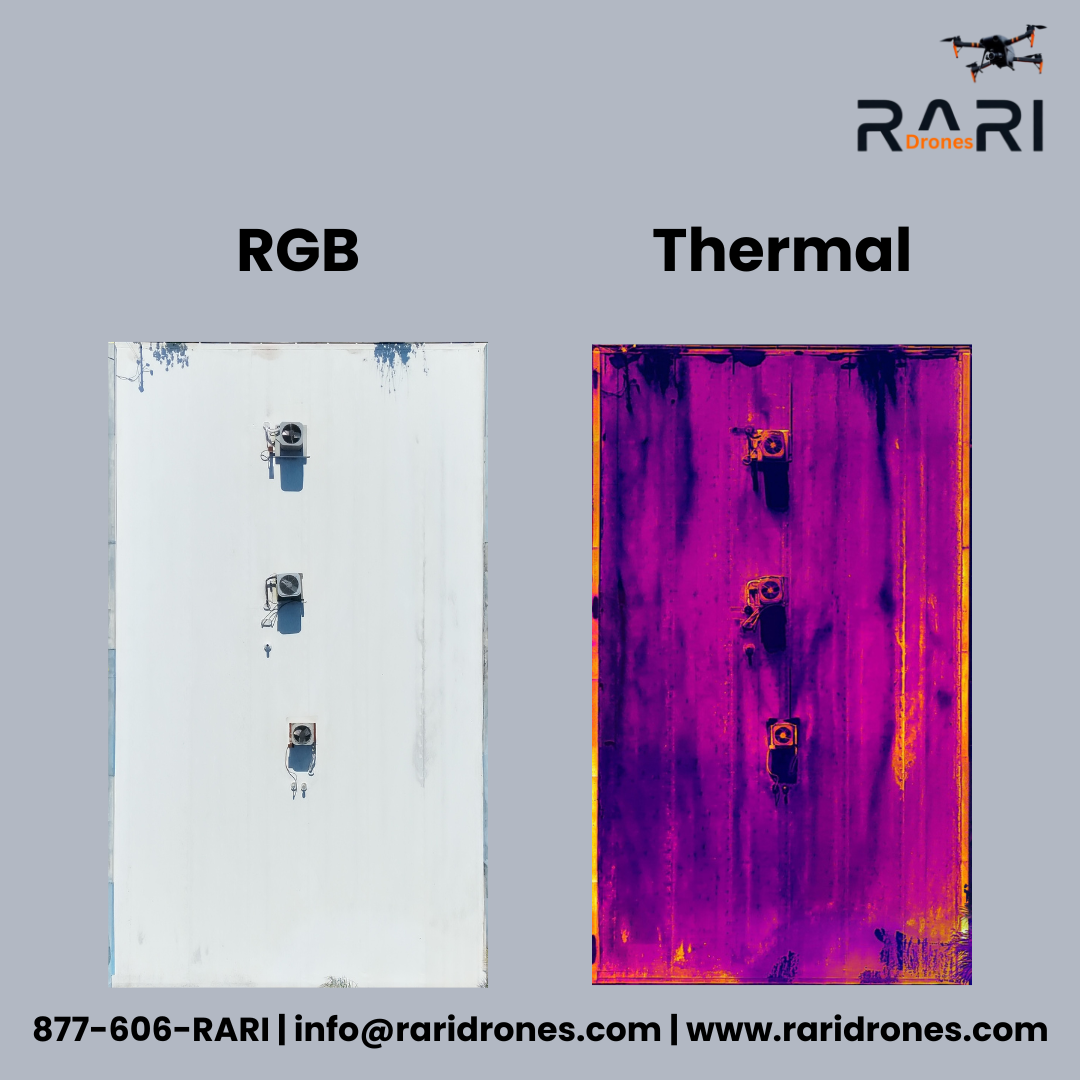
RGB vs. Thermal drone roof inspection. Thermal imaging reveals hidden moisture and possible insulation failures invisible to standard photography.
What Is a Thermal Drone Roof Inspection?
A thermal drone roof inspection uses an infrared camera mounted on a professional drone to detect temperature differences across a roof's surface. These temperature variations reveal problems hidden beneath the surface like moisture intrusion, insulation failures, trapped heat, and active leaks. These problems are completely invisible to the naked eye and a standard camera.
At RARI Drones, we use the DJI Matrice 4TD, a professional-grade platform equipped with both a high-resolution RGB camera and a radiometric thermal sensor. This allows us to capture standard visual imagery and thermal data simultaneously during every flight, giving property owners and roofing professionals the complete picture.
Why Thermal? What Your Eyes Can't See.
A traditional visual roof inspection, whether from a ladder or a drone, can only identify surface-level damage: missing shingles, cracked tiles, and visible wear. That's important, but it's only half the story.
The real threats to a roof are often hidden underneath. Moisture trapped beneath the membrane, insulation that's compressed or missing, or a slow leak that won't show up on the ceiling for possibly months, but is already rotting the decking from the inside out.
Thermal imaging detects these issues because wet or damaged materials retain and release heat differently than dry, healthy ones.
After a full day of sun exposure a roof heats up. As it cools in the evening, areas holding moisture cool at a different rate than the surrounding dry material. That temperature contrast shows up clearly on thermal imaging, even when the surface looks perfectly fine.
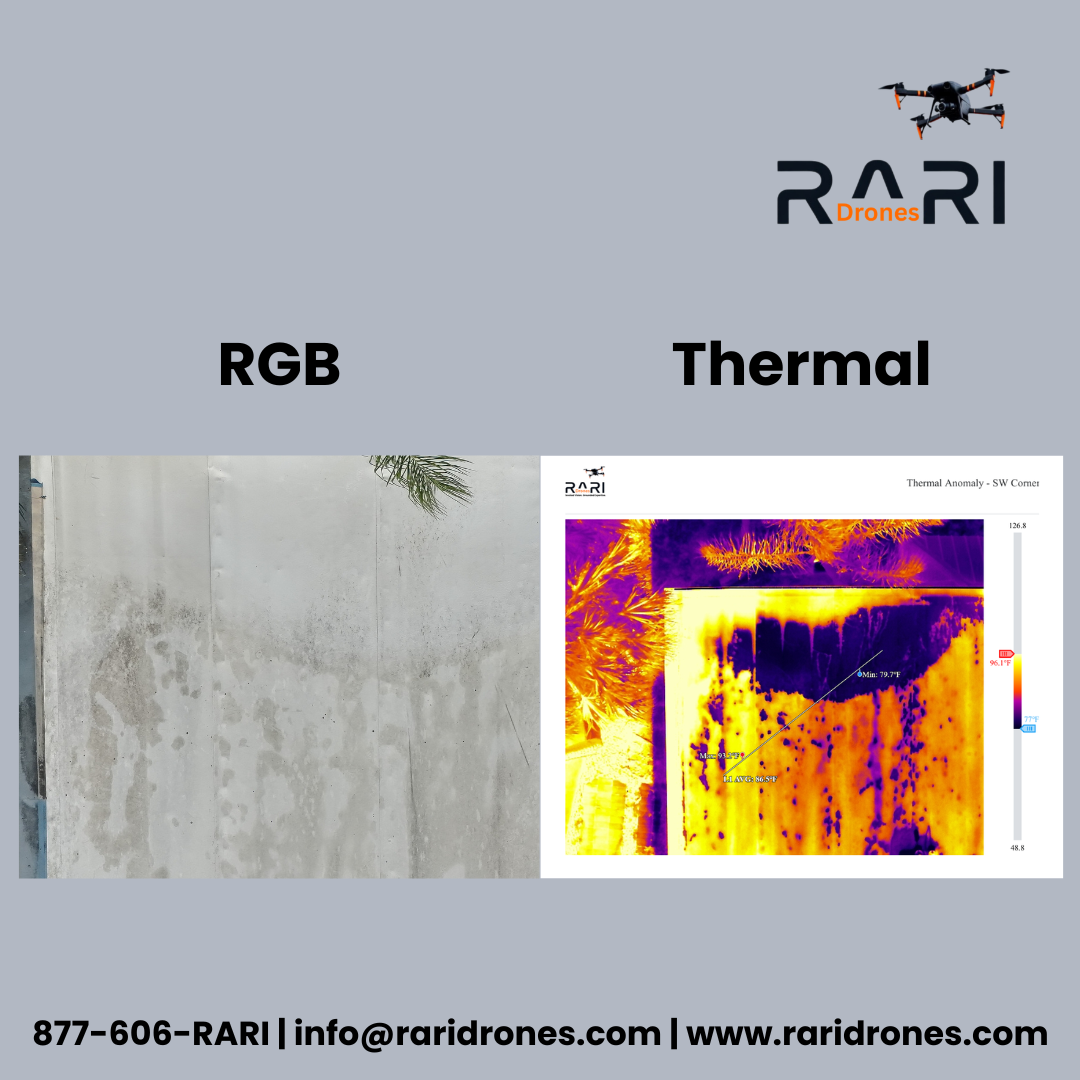
Thermal analysis of a commercial roof corner. Temperature differentials reveal possible moisture intrusion invisible in the standard RGB image.
That's why we fly thermal missions at specific times: early morning or after sunset, when the temperature differential between wet and dry areas is at its peak.
What Can Thermal Imaging Detect on a Roof?
Thermal drone inspections can identify a range of issues that would otherwise go undetected until serious damage has already occurred.
Moisture Intrusion & Trapped Water: The most common finding. Water trapped beneath roofing membranes, under tiles, or in the decking shows up as distinct warm or cool anomalies depending on the time of day. Left undetected, trapped moisture leads to mold, rot, and structural failure.
Active Leaks: A thermal scan can pinpoint exactly where water is entering, even when the interior ceiling stain is ten feet away from the actual breach. Water travels along decking and structural members before it drips. Thermal imaging shows you the source, not just the symptom.
Insulation Deficiencies: Missing, compressed, or water-damaged insulation creates hot spots on the roof surface. These areas mean higher energy bills and accelerated wear on the roofing material above them. Thermal imaging maps these deficiencies across the entire roof in a single flight.
Ponding Water: Flat and low-slope commercial roofs are especially susceptible to standing water. Thermal imaging reveals areas where water is collecting even after it has partially evaporated, identifying drainage problems before they cause membrane failure. Our thermal inspection methodology follows ASTM C1153, the industry standard practice for locating wet insulation in roofing systems using infrared imaging.
HVAC & Mechanical Issues: Thermal scans can reveal HVAC equipment that's leaking conditioned air, failing seals around rooftop penetrations, and exhaust systems creating abnormal heat patterns that accelerate roof degradation in localized areas.
Flashing & Penetration Failures: Every pipe, vent, skylight, and HVAC unit that penetrates the roof surface is a potential failure point. Thermal imaging highlights compromised flashing and sealant failures around these penetrations.
RGB + Thermal: The Full Picture.
We never deliver thermal data alone. Every RARI Drones roof inspection includes both RGB (standard visual) and thermal imagery, because each tells a different part of the story.
RGB captures what you can see: physical damage, missing materials, debris, biological growth, and overall roof condition. Thermal captures what you can't see: moisture, heat loss, insulation gaps, and subsurface failures.
When you compare the two, you get a complete diagnostic picture. You can see exactly WHERE the damage is on the visual image and WHAT is happening beneath the surface on the thermal image. Our reports present these side by side with annotations so there's no guesswork, just clear and actionable data.
How Do We Fly a Thermal Roof Inspection?
Our thermal inspection workflow is designed to maximize data quality:
1. Pre-Dawn or Post-Sunset Arrival: We schedule thermal flights during the optimal window when temperature differentials are most pronounced. This often means we're set up and flying before sunrise.
2. Thermal Mapping Mission: After creating the flight plan, the drone flies a systematic grid pattern over the entire roof, capturing overlapping thermal images that are processed into a complete thermal orthomosaic. A single, measurable, high-resolution thermal map of the entire roof.
3. Thermal Detail Shots: After the mapping mission, we perform a manual scan of the roof using split-screen RGB and thermal. When we spot an anomaly, we isolate it in full-screen thermal, zoom tight, and capture a detailed shot with temperature data intact.
4. RGB Mission: Once the sun is up, we fly a standard RGB mapping mission and capture detailed visual images of any physical damage, wear, or areas of concern.
5. Processing & Reporting: All data is processed and compiled into a professional report with annotated imagery, temperature readings, GPS-stamped locations, and clear findings. Reports are delivered within 48 hours.
The result: one visit, two missions, and a complete diagnostic package that no ladder inspection or visual-only drone flight can match.
15 Years of Reading Thermal, Not Just Flying a Drone.
Here's what makes RARI Drones different from other drone operators offering thermal services.
Most drone pilots learned thermal imaging from a weekend course. They can fly the drone and capture the images, but interpreting what those images actually mean is an entirely different skill.
I'm Patrick Donovan, owner and operator of RARI Drones, and a retired Firefighter/Paramedic with over 15 years of hands-on thermal imaging experience. In the fire service, thermal imaging isn't a nice-to-have, it's a lifesaving tool. I used thermal cameras to locate victims in zero-visibility conditions, detect fire behind walls and above ceilings, identify structural hot spots, and make real-time decisions where seconds mattered.
That experience doesn't disappear when you change industries. The same principles that allow a firefighter to read heat signatures through a burning structure apply directly to reading moisture patterns, insulation failures, and thermal anomalies on a roof. The sensor is the same. The principles are the same. The difference is 15 years of doing it when lives were on the line versus learning it from a tutorial.
When RARI Drones delivers a thermal report, the analysis comes from someone who has spent over a decade and a half interpreting thermal data in the most demanding conditions imaginable.
Who Benefits from Thermal Roof Inspections?
Roofers & Contractors: Thermal data helps you diagnose problems accurately, scope repairs precisely, and justify your recommendations to customers with hard evidence. This allows you to show your client exactly where the moisture is and exactly what needs to be addressed.
Insurance Adjusters: Thermal imaging provides objective, measurable data to support or evaluate claims. Temperature readings, GPS coordinates, and annotated imagery create documentation that holds up. Combined with RGB imagery, thermal reports give adjusters the complete picture they need to process claims accurately and efficiently.
Property Managers & HOAs: Managing multiple roofs across a portfolio? Thermal inspections allow you to prioritize repairs and budget for replacements based on actual condition data, not just age or visual appearance.
Commercial Building Owners: Large flat roofs are expensive to replace and prone to hidden moisture accumulation. A thermal scan can identify problem areas early, allowing targeted repairs instead of full replacement, saving thousands.
Florida Roofs and Why Thermal Matters.
Florida's climate is uniquely hard on roofs. Intense UV exposure, daily summer thunderstorms, hurricane-force winds, hail, and year-round humidity create a relentless cycle of stress that accelerates roof deterioration.
Here in Tampa Bay, a roof that looks fine with the naked eye or with a high-resolution image, could be holding trapped moisture from last week's afternoon storm. That moisture sits under the membrane in 95+ degree heat, creating the perfect environment for mold, rot, and structural decay. By the time it shows up as a water stain on your ceiling, the damage could have been spreading for months.
Thermal imaging catches these problems early, often months to even years before they become visible. In a state where roof condition directly impacts your insurance coverage and premiums, knowing the true condition of your roof isn't optional, it's essential.
Schedule Your Thermal Roof Inspection:
RARI Drones proudly serves Tampa Bay and the surrounding counties of Pasco, Hillsborough, Pinellas, and Hernando. Whether you're a roofer who wants better diagnostics, or an adjuster who wants solid documentation, we deliver professional-grade Thermal and RGB inspection data you can trust.
📞 877-606-RARI
🌐 www.raridrones.com
RARI Drones provides aerial thermal and visual imaging services for documentation and diagnostic support. We are not licensed home inspectors, roofing contractors, or structural engineers. Our reports are intended to identify and document thermal anomalies and visible conditions. They do not constitute a home inspection, structural assessment, or warranty evaluation. All findings should be reviewed by the appropriate licensed professional for final diagnosis and repair recommendations.
All flights are conducted in full compliance with FAA Part 107 regulations.